

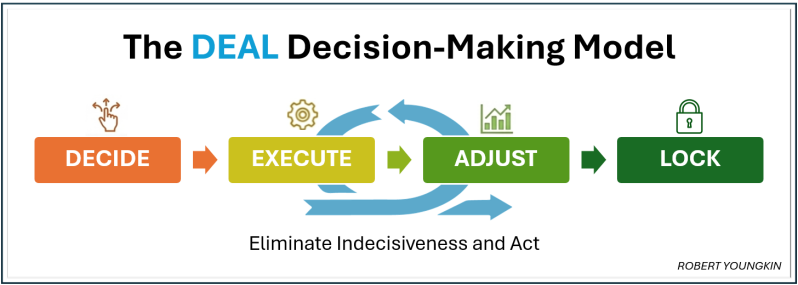
The DEAL Decision-Making Model
DEAL is designed to favor action over inaction and to eliminate indecisiveness. We often hold off on a decision until we feel we have enough information to get it right. In theory, that makes sense. In business, we rarely have that luxury. People are naturally risk-averse and fear failure, change, and incompleteness, and a decision that feels early carries all three. In most cases, though, execution creates opportunities to adjust and dial in the result.
DEAL draws on John Boyd’s OODA loop and W. Edwards Deming’s PDCA cycle, but distills them into one action-first approach: make a decision and go. Its philosophy is influenced by the Agile approach common in software development: if we discover problems early, we can fix them early. Agile fits software naturally and takes more adaptation elsewhere, but the core principle applies beyond it. In business, time to market is usually critical and schedules are tight, so discovering a late issue because you waited for perfection can be costly. Businesses want to learn of problems early so they can fix them, or prepare for them.
DEAL gives you a simple path from decision to standard:
- Decide: Make the call with the data you have today. Define what success looks like, how you will measure it, and who owns it. A good decision now almost always beats a perfect decision next week. Match your rigor to the cost of reversing the call: move fast on decisions that are easy to undo, and take more care on the ones that are not. Deciding doesn’t mean going in blindly. It means avoiding analysis paralysis and moving forward even when you feel slight discomfort. Don’t wait for perfection; target the “Good Enough” point.
- Execute: Act immediately. Real-world motion produces feedback and data that analysis alone never can. This is where you collect data and see where your decision falls short. The objective is to fail fast and early, keeping failures small and affordable, so you can correct issues before they become the standard.
- Adjust: Measure results in flight against the success criteria you set up front, then tune your course without slowing the team. Repeat the loop between Execute and Adjust as quickly as possible, as many times as needed, until you hit the target. If it isn’t converging, stop and reconsider the decision instead of looping indefinitely. When you hit the target, lock it in.
- Lock: When the results hold against your criteria, make the decision the standard. Reopen it only when conditions materially change, such as a new requirement, a supplier or technology shift, or a performance trend that moves away from target.
The point: Eliminate indecisiveness and act. Decisions improve through execution, not delay.
Case Study: The MRAP Program, 2007
Few acquisition efforts show the DEAL model at work as clearly as the Mine-Resistant Ambush Protected (MRAP) program. Facing mounting casualties from roadside bombs in Iraq, Defense Secretary Robert Gates did not wait for the normal development cycle to deliver a perfect solution. He made blast-resistant vehicles the department’s top acquisition priority, bought from multiple vendors at once, and learned from real-world use as thousands of vehicles reached the field. What followed is a useful illustration of the full DEAL sequence: a decision made on incomplete information, rapid execution, adjustments driven by field feedback, and a partial lock as proven vehicles became part of the standing force. It also shows the tradeoffs of moving fast, which makes it a fitting example of matching rigor to the cost of reversing a decision.
- The Decide: Roadside bombs were causing heavy casualties in Iraq. In 2007, Gates made Mine-Resistant Ambush Protected (MRAP) vehicles the department’s top acquisition priority. Instead of waiting for the usual development cycle, the services were bought from several vendors at once and tested while production ramped up. They accepted the risk of buying vehicles before every design question was settled.
- The Execute: Thousands of vehicles reached theater within roughly a year, far faster than a normal program of record.
- The Adjust: Field experience exposed limits that testing would have been slow to find. In Afghanistan, the first MRAPs were often too big and heavy for narrow roads, bridges, and rough terrain. That feedback led to a lighter, more mobile variant, the M-ATV, awarded in 2009 and fielded quickly. Program leaders also found they had bought many variants, which complicated maintenance and logistics, and they adjusted over time.
- The Lock: The vehicles that proved themselves were not treated as a temporary surge buy. A portion of the MRAP and M-ATV fleet was kept after the drawdown and folded into the services’ regular force structure, with formal sustainment and training. Blast protection and off-road mobility became standing expectations for future vehicle requirements. The standard was revisited only when conditions materially changed, such as the end of major combat operations, which reduced the number of vehicles needed.
Why it fits DEAL:
- It is a hardware example, not a tactical one, and it runs on the same loop of deciding on incomplete data, learning from real use, and correcting courses.
- It shows the cost of speed honestly. Concurrent buying and testing created logistics burdens, which supports the “match rigor to reversibility” language in your text. Here the urgency came from lives at risk, which justified the tradeoff.